 By Owen Palmer
Updated November 2026
Buying an ecoflow gas & benzin smart generator dual fuel inverter means balancing three things: how quiet it runs (measured in dBA at roughly 23 feet, as manufacturers typically specify), how long it can run on a tank, and whether it can switch between gasoline and propane without fuss. This list ranks six dual fuel inverter models on noise rating, runtime specifications, RV and home-backup readiness, and the patterns owners tend to report. Nothing here comes from our own testing.
Our top picks at a glance
- 1
 TOP CHOICEBest overallWestinghouse 2800 Peak Watt Super Quiet & Lightweight Dual Fuel PortabView on Amazon
- 2
 TOP CHOICEBest for long runtimePowerSmart 3800 Watt Dual Fuel Portable Inverter Generator for Home UseView on Amazon
- 3
 TOP CHOICEBest for campingPowerSmart 3800 Watt Dual Fuel Inverter Generator for Camping or Home UseView on Amazon
- 4
 Best for RV hookupsChampion 4000-Watt Dual Fuel RV Ready Portable Inverter GeneratorView on Amazon
- 5
 Best for light RV loadsWEN Quiet and Lightweight 3600-Watt Dual Fuel RV-Ready Portable InvertView on Amazon
- 6
 Best for electric startWEN Quiet and Lightweight 4800-Watt Dual Fuel RV-Ready Electric StartView on Amazon
Our Top Picks
Quick Comparison
| Product | Best for | Key feature |
|---|---|---|
| Westinghouse 2800 Peak Watt Dual Fuel Inverter | Overall balance | CO sensor, parallel capable |
| PowerSmart 3800 Watt Home Use Generator | Long runtime | 8-hour runtime, under 59 dBA |
| PowerSmart 3800 Watt Camping Generator | Camping | CO protect, under 3% THD |
| Champion 4000-Watt RV Ready Generator | RV hookups | LPG hose, 3-year warranty |
| WEN DF360iX 3600-Watt Generator | Light RV loads | Fuel shut-off, CO Watchdog |
| WEN DF480iX 4800-Watt Electric Start | Electric start | Electric start, higher output |
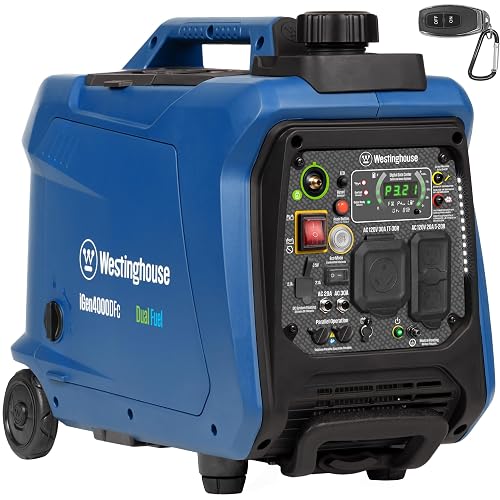
Westinghouse 2800 Peak Watt Super Quiet & Lightweight Dual Fuel Portable Inverter Generator
Westinghouse 2800 Peak Watt Super Quiet & Lightweight Dual Fuel Portable Inverter Generator, Gas & Propane Powered, CO Sensor, Parallel Capable, Long Run Time
Best for: Overall balance of noise, portability and safety features
Suited to buyers who want a light, quiet unit for occasional home backup or tailgating, and who value a built-in carbon monoxide sensor.
Pros
- Listed as super quiet and lightweight for its class
- Parallel capable for adding output later
Cons
- Lower peak output limits heavy appliance use
PowerSmart 3800 Watt Dual Fuel Portable Inverter Generator for Home Use
Gas/Propane Powered, 8H Long Runtime, Super Quiet <59dBA, Parallel Ready, Digital Display PowerSmart 3800 Watt Dual Fuel Portable Inverter Generator for Home Use
Best for: Long runtime on a single tank
A fit for homeowners who need several hours of steady power during outages and want a digital readout for monitoring load.
Pros
- Listed runtime of about 8 hours at partial load
- Noise rating under 59 dBA per manufacturer specs
Cons
- Heavier than smaller portable units
PowerSmart 3800 Watt Dual Fuel Inverter Generator for Camping or Home Use
PowerSmart8H Run Time, Ultra-Quiet <59 dBA, CO Protect, Clean Power <3% THD, Parallel Ready 3800 Watt Dual Fuel Inverter Generator for Camping or Home Use
Best for: Quiet camping and campsite power
Aimed at campers and weekend users who need low noise in shared spaces and clean power for sensitive electronics.
Pros
- Listed clean output under 3% total harmonic distortion
- CO protection and parallel readiness
Cons
- Fuel runtime is shorter than the home-use sibling model
Champion 4000-Watt Dual Fuel RV Ready Portable Inverter Generator
Gas & Propane Powered, LPG Hose, RV Ready, Recoil Start, Parallel Ready, Quiet Technology, Free 3-Year Warranty Champion 4000-Watt Dual Fuel RV Ready Portable Inverter Generator
Best for: RV hookups and propane operation
Best suited to RV owners who want an included LPG hose and a generator they can run on propane for longer, cleaner storage.
Pros
- Includes an LPG hose and RV-ready configuration
- Manufacturer lists a 3-year warranty
Cons
- Recoil start only, no electric start
WEN Quiet and Lightweight 3600-Watt Dual Fuel RV-Ready Portable Inverter Generator (DF360iX)
WEN Quiet and Lightweight 3600-Watt Dual Fuel RV-Ready Portable Inverter Generator with Fuel Shut Off and CO Watchdog (DF360iX)
Best for: Light RV loads and safety-focused setups
A practical option for campers running air conditioners on low settings, lights and phone chargers, with fuel shut-off and CO monitoring included.
Pros
- Fuel shut-off and CO Watchdog listed as standard
- Lightweight for its output class
Cons
- 3600 W may fall short for large RV air conditioners
Buying Guide
Noise Level
Noise is often the deciding factor for campers, RV owners, and neighbors on a shared lot. Manufacturers usually list noise in dBA measured at about 23 feet, and a lower number means a quieter machine at that distance. Keep in mind that the rating depends on load and the eco mode setting, so compare figures measured under similar conditions.
Runtime and Fuel Tank Capacity
Runtime listed on the spec sheet is usually based on a partial load, so real-world results will vary with what you plug in. Check the fuel tank size and the stated hours on gasoline and on propane separately, since propane often gives a different run time than gasoline. Longer run times mean fewer refills during a power outage or a long camping trip.
Dual Fuel Switching and Fuel Options
A true dual fuel unit lets you run on gasoline or propane, which is helpful when one fuel source is hard to find. Look at how the switch works and whether the unit needs an LPG hose or adapter for propane tanks. Make sure the fuel options match what you can reliably get where you plan to use the generator.
Power Output and Parallel Capability
Add up the wattage of the devices you need to run, and choose a generator with enough running watts, not just peak watts. If you may need more power later, check whether the model supports parallel connection with a matching unit. Clean power ratings, such as low total harmonic distortion, matter for sensitive electronics.
Safety Features and Warranty
Carbon monoxide sensors, automatic shutoffs, and low-oil protection add real value, especially when you run a generator near living spaces. Review the warranty length and coverage, since it can say a lot about how the manufacturer expects the unit to hold up over time.
FAQ
Can a dual fuel inverter generator run on both gasoline and propane?
Yes, dual fuel models are designed to run on either gasoline or propane, and many let you switch between them while the engine is running or after shutting down. Performance and runtime usually differ between the two fuels, so check the specifications for each. Always follow the manual when changing fuel types.
Are inverter generators quieter than conventional generators?
Inverter generators typically run quieter because the engine speed adjusts to the load rather than running at a constant high speed. Noise ratings still vary between models, so compare dBA figures instead of assuming all inverters are equally quiet. Placement and load also affect how loud the unit sounds.
Can I connect two units to get more power?
Some models are labeled parallel ready, which means two matching units can be linked with a compatible cable to share a larger load. Only pair identical models from the same manufacturer, and confirm the parallel kit is sold separately or included. Check the manual before connecting anything.
Is a carbon monoxide sensor necessary on a portable generator?
A carbon monoxide sensor is a helpful safety feature, but it does not replace safe operation. Generators must always run outdoors, well away from windows, doors, and vents, regardless of sensors. Test any detector regularly and keep spare batteries on hand.
Can I use a dual fuel generator for RV or home backup?
Many dual fuel inverter generators are marketed as RV ready and work well for both camping and emergency home backup. For a home setup, a transfer switch or a properly installed interlock kit is needed to safely connect to household wiring. Confirm the outlets and wattage fit your needs before relying on the unit.
How often should I service a dual fuel inverter generator?
Follow the maintenance schedule in your owner’s manual, which generally covers oil changes, air filter checks, and spark plug inspections. Propane and gasoline can affect service intervals, so note any differences. Regular maintenance helps keep the unit reliable and extends its service life.
Conclusion
If quiet operation and campsite-friendly noise levels matter most, prioritize models with the lowest dBA ratings and strong eco modes. If you need the longest runtime or higher power for home backup or RV use, focus on fuel capacity, running watts, and parallel capability instead.
For shoppers who want the most safety features and a solid warranty, look for models with carbon monoxide protection and clear switching between gasoline and propane. Match the generator to your real power needs and typical fuel supply, and you will end up with a dual fuel inverter that fits your situation well.
Related reading
- EcoFlow Smart Generator 4000 Dual Fuel Review: Is It Worth It?
- Westinghouse Dual Fuel Inverter Generator with Remote Start: 7 Best Picks (2026)
- WEN 6800 Dual Fuel Inverter Generator Review: Is It Worth It?
- Top 7 Champion 5500W Dual Fuel Inverter Generator Picks Compared
- Top 5 Dual Fuel Generator Inverter Models for Home Backup and RV Use
- Top 5 240 Volt Inverter Generator Dual Fuel Picks for Home Backup
- Pulsar 4000-watt Dual Fuel Inverter Generator: A Practical Guide (2026)
About Owen Palmer
Owen Palmer is part of our editorial team and reviews and edits our generators & noise guides, checking product details against manufacturer specifications and owner feedback.