 By Owen Palmer
Updated November 2026
Choosing a quiet generator for RV with remote start means balancing three things: how loud it runs at your campsite, whether it can switch between gasoline and propane, and how easily you can start it from inside the coach. The picks below are based on manufacturer specifications, product listings and patterns in owner feedback. Noise figures are the main factor, followed by fuel flexibility, remote start reliability and RV-specific features like parallel capability.
Our top picks at a glance
- 1
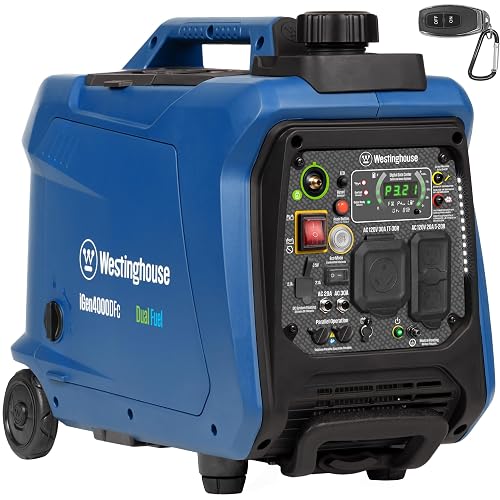 TOP CHOICEBest overallWestinghouse 4000 Peak Watt Super Quiet Dual Fuel Portable Inverter GeneratorView on Amazon
- 2
 TOP CHOICEBest for larger rigsWestinghouse 5000 Peak Watt Super Quiet Portable Inverter GeneratorView on Amazon
- 3
 TOP CHOICEBest for extra capacityWEN 6800-Watt Dual Fuel RV-Ready Electric Start Portable Inverter GeneratorView on Amazon
- 4
 Best for portability4300W Dual Fuel Inverter Generator Quiet for RV Camp Home BackupView on Amazon
- 5
 Best for home backupWestinghouse 8200 Peak Watt Tri-Fuel Portable Inverter GeneratorView on Amazon
Our Top Picks
Quick Comparison
| Product | Best for | Key feature |
|---|---|---|
| Westinghouse 4000 Peak Watt Super Quiet Dual Fuel | Overall quiet running | Remote electric start, dual fuel |
| Westinghouse 5000 Peak Watt Super Quiet | Larger rigs | Auto choke, wheel kit |
| WEN 6800-Watt Dual Fuel RV-Ready | Extra capacity | Fuel shut-off, CO watchdog |
| 4300W Dual Fuel Inverter Generator | Portability | 64 lb wheels kit |
| Westinghouse 8200 Peak Watt Tri-Fuel | Home backup | Transfer switch ready |
Westinghouse 4000 Peak Watt Super Quiet Dual Fuel Portable Inverter Generator
Westinghouse 4000 Peak Watt Super Quiet Dual Fuel Portable Inverter Generator, Remote Electric Start, Gas & Propane Powered, RV Ready, CO Sensor, Parallel Capable
Best for: Overall quiet running
Suited to couples and small families who want dependable power for air conditioning on a modest rig without a loud, disruptive engine note.
Pros
- Remote electric start with gas or propane
- Parallel capable for future expansion
Cons
- Output may not cover large roof air conditioners alone
Westinghouse 5000 Peak Watt Super Quiet Portable Inverter Generator
Westinghouse 5000 Peak Watt Super Quiet Portable Inverter Generator, Remote Electric Start with Auto Choke, Wheel & Handle Kit, RV Ready, Gas Powered, Parallel Capable
Best for: Larger rigs
A good match for travel trailers and motorhomes running two air conditioners or a microwave alongside lighting and electronics.
Pros
- Auto choke simplifies remote starting
- Wheel and handle kit eases moving it around the site
Cons
- Gasoline-only operation limits fuel options
WEN 6800-Watt Dual Fuel RV-Ready Electric Start Portable Inverter Generator
WEN 6800-Watt Dual Fuel RV-Ready Electric Start Portable Inverter Generator with Fuel Shut Off and CO Watchdog for Electric Vehicle Backup (DF680iX)
Best for: Extra capacity
Fits owners who want headroom for heavier loads, including electric vehicle charging backup, without moving up to a larger frame.
Pros
- Fuel shut-off and CO watchdog add safety margin
- Dual fuel with electric start
Cons
- Heavier to move than smaller inverter units
4300W Dual Fuel Inverter Generator Quiet for RV Camp Home Backup
Remote/Electric Start. 64lbs Wheels Kit. Gas Propane Powered. 34h Propane Runtime. CO Auto-Shutoff. Parallel Ready. 4300W Dual Fuel Inverter Generator Quiet for RV Camp Home Backup
Best for: Portability
Works for campers who set up and break down often and want a unit that rolls easily over gravel and uneven pads.
Pros
- Wheels kit and long propane runtime listed
- CO auto-shutoff and parallel ready
Cons
- Lower wattage limits how many appliances run at once
Westinghouse 8200 Peak Watt Tri-Fuel Portable Inverter Generator
Westinghouse 8200 Peak Watt Tri-Fuel Portable Inverter Generator, Remote Electric Start, Transfer Switch Ready, Gas, Propane, Natural Gas, Low THD, Safe for Electronics, Parallel Capable, CO Sensor
Best for: Home backup
Aimed at owners who want one generator for the RV and for household outages, with clean output for sensitive electronics.
Pros
- Tri-fuel: gasoline, propane and natural gas
- Low THD output listed as safe for electronics
Cons
- Largest and heaviest of the five picks
Buying Guide
Noise rating and running load
Manufacturers usually list decibel levels at a set distance, often about 23 feet, and at a specified load. A unit rated lower at half load will sound quieter at a typical campsite, so compare figures at the same load. Check the rating at the load you actually expect to run.
Fuel flexibility
Dual fuel models switch between gasoline and propane, which helps when fuel is scarce or when you want quieter, cleaner running on propane. Confirm the propane runtime listed, since it can differ noticeably from gasoline runtime.
Remote start and auto choke
Remote start lets you run the generator from inside the rig, but reliability depends on the battery and wiring. Models with auto choke reduce the chance of a failed start in cold weather.
Parallel capability and output type
Parallel capable units can be linked to double output later. Inverter output with low total harmonic distortion is generally gentler on electronics than conventional output.
Good picks for this: Westinghouse 4000 Peak Watt Super Quiet Dual Fuel and Westinghouse 8200 Peak Watt Tri-Fuel
FAQ
Is a dual fuel generator quieter than gasoline only?
Many owners report that propane runs slightly smoother and quieter than gasoline, but the difference depends on the engine and load. Check the decibel rating for each fuel if the manufacturer lists it.
Related reading
- Whisper Quiet Generator for RV: Which Models Are Truly Quiet?
- Top 5 Quiet Generators for RV 30 Amp Picks Compared for Campers
- Quiet Generator with 50 Amp Plug: 6 Best Picks for Home and RV (2026)
- Quiet Generator for RV: 7 Steps to Cut Noise at Your Campsite
- Quiet 50 Amp Generator for RV: 6 Best Picks Compared (2026)
- Quiet 4000-watt Generator for Rv: A Practical Guide (2026)
About Owen Palmer
Owen Palmer is part of our editorial team and reviews and edits our generators & noise guides, checking product details against manufacturer specifications and owner feedback.


