 By Miles Sinclair
Updated November 2026
Shopping for the best dual fuel generator for house backup means balancing three things: how many watts you need to keep essentials running, whether you can run it on gasoline and propane, and how loud it will be at night. This list focuses on portable dual fuel units that owners commonly use for home backup, with attention to wattage, transfer switch readiness, 30-amp outlets, CO protection and noise output.
Our top picks at a glance
- 1
 TOP CHOICEBest overallWestinghouse 6500 Watt Dual Fuel Home Backup Portable GeneratorView on Amazon
- 2
 TOP CHOICEBest for whole-home powerDuroMax XP13000EH 13,000-Watt Dual Fuel Portable GeneratorView on Amazon
- 3
 TOP CHOICEBest for RV and camping crossoverWestinghouse 4650 Peak Watt Dual Fuel Portable GeneratorView on Amazon
- 4
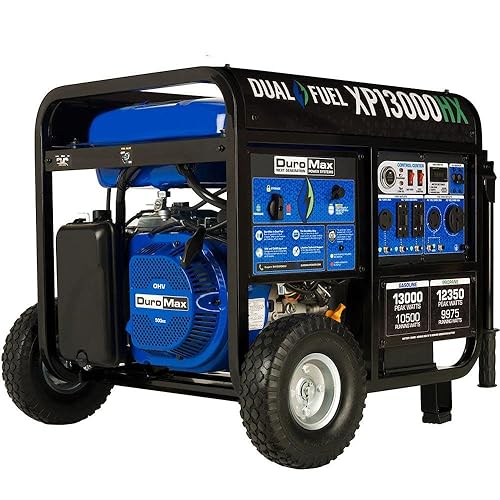 Best for heavy-duty loadsDuroMax XP13000HX 13,000-Watt Dual Fuel Portable GeneratorView on Amazon
- 5
 Best for quiet, clean powerPowerSmart 3800 Watt Dual Fuel Inverter GeneratorView on Amazon
Our Top Picks
Quick Comparison
| Product | Best for | Key feature |
|---|---|---|
| Westinghouse 6500 Watt Dual Fuel Home Backup Portable Generator | Overall home backup | Transfer switch ready 30A outlet |
| DuroMax XP13000EH 13,000-Watt Dual Fuel Portable Generator | Whole-home power | 13,000 watts, electric start |
| Westinghouse 4650 Peak Watt Dual Fuel Portable Generator | RV and camping crossover | RV ready 30A outlet |
| DuroMax XP13000HX 13,000-Watt Dual Fuel Portable Generator | Heavy-duty loads | Whole-home backup capacity |
| PowerSmart 3800 Watt Dual Fuel Inverter Generator | Quiet, clean power | Under 59 dBA, under 3% THD |
Westinghouse 6500 Watt Dual Fuel Home Backup Portable Generator
Westinghouse 6500 Watt Dual Fuel Home Backup Portable Generator, Transfer Switch Ready 30A Outlet, RV Ready 30A Outlet, CO Sensor
Best for: Overall home backup
This suits homeowners who want a mid-large unit that can feed a transfer switch and run a refrigerator, furnace fan and lights during an outage.
Pros
- Transfer switch ready 30A outlet
- Built-in CO sensor
Cons
- Heavy enough to need two people to move
DuroMax XP13000EH 13,000-Watt Dual Fuel Portable Generator
DuroMax XP13000EH 13,000-Watt Dual Fuel Portable Generator – Gas & Propane, Electric Start, Whole Home Backup Power, Transfer Switch Ready, RV & Emergency Ready
Best for: Whole-home power
Owners who need to power a larger share of the house, including well pumps and central air, often look at units in this wattage class.
Pros
- 13,000-watt rating for high starting loads
- Electric start and transfer switch readiness
Cons
- Large footprint and weight for a portable unit
Westinghouse 4650 Peak Watt Dual Fuel Portable Generator
Westinghouse 4650 Peak Watt Dual Fuel Portable Generator, RV Ready 30A Outlet, Gas & Propane Powered, CO Sensor
Best for: RV and camping crossover
A good fit for households that want one machine for outages and occasional trips, since the RV ready outlet makes it easy to power a trailer.
Pros
- RV ready 30A outlet
- CO sensor included
Cons
- Lower peak output limits how many appliances run at once
DuroMax XP13000HX 13,000-Watt Dual Fuel Portable Generator
DuroMax XP13000HX 13,000-Watt Dual Fuel Portable Generator – Gas & Propane, Electric Start, Whole Home Power Backup, Transfer Switch Ready, RV & Emergency Ready
Best for: Heavy-duty loads
This model targets buyers who expect long outages and plan to run power tools, well equipment and HVAC together.
Pros
- High wattage for demanding loads
- Gas and propane operation
Cons
- Noisier than inverter designs at full load
PowerSmart 3800 Watt Dual Fuel Inverter Generator
PowerSmart8H Run Time, Ultra-Quiet <59 dBA, CO Protect, Clean Power <3% THD, Parallel Ready 3800 Watt Dual Fuel Inverter Generator for Camping or Home Use
Best for: Quiet, clean power
Best suited to households with sensitive electronics or neighbors close by, where a lower noise floor matters more than raw wattage.
Pros
- Listed under 59 dBA and under 3% THD
- Parallel ready for added capacity
Cons
- 3800 watts will not run a whole house
Buying Guide
Match wattage to your critical loads
Add the running watts of the appliances you must keep on, then add the starting surge of motor loads like refrigerators and well pumps. Manufacturers list both running and peak ratings, so check both before choosing.
Check transfer switch and outlet options
A transfer switch lets you feed house circuits safely, while a 30A RV outlet is useful for larger loads. Confirm the outlet type matches your installation before buying.
Weigh noise against output
Inverter designs typically run quieter and cleaner than conventional open-frame units, but they usually give less power per dollar of size. Compare the dBA rating at the load you expect, not just at idle.
Plan for carbon monoxide safety
Never run any generator indoors or in an attached garage. A built-in CO sensor is helpful but does not replace proper outdoor placement and ventilation.
Good picks for this: Westinghouse 6500 Watt Dual Fuel Home Backup Portable Generator and PowerSmart 3800 Watt Dual Fuel Inverter Generator
FAQ
What does dual fuel mean for a home backup generator?
A dual fuel generator can run on either gasoline or propane, so you are not stuck if one fuel supply is limited. Propane is often favored for longer storage life, while gasoline is typically easier to find in an emergency. Check the manufacturer’s instructions for fuel type and fuel use settings before you run the unit.
How many watts do I need to back up my house?
Start by adding up the running watts of the essentials you want to keep on, such as a refrigerator, sump pump, furnace fan and a few lights. Remember that motors and compressors need extra starting watts, so the peak rating matters too. If you want to power most of a home, a 13,000-watt class unit is usually the better fit than a smaller model.
Do I need a transfer switch to use a dual fuel generator at home?
A transfer switch is strongly recommended if you plan to connect the generator to your home’s wiring. It safely isolates your house from the utility grid so power does not flow back into utility lines, which can endanger line workers. Never plug a generator directly into a household outlet without proper isolation.
Is a 30-amp outlet necessary for whole-house backup?
A 30-amp outlet is useful when you want to connect the generator to a compatible transfer switch or power heavier loads like a window air conditioner or electric dryer. It also matches the outlet style used by many RV and heavy-duty cords. If you only need to run small appliances, standard household outlets may be enough.
How do I keep a generator safe from carbon monoxide?
Always run a generator outdoors, far from windows, doors and vents, and never in a garage or enclosed space, even with the door open. Install battery-powered CO alarms inside your home and test them regularly. A generator with a built-in CO sensor adds another layer of protection, but it does not replace proper placement and alarms.
How often should I run and maintain a dual fuel generator?
Run the generator under light load periodically to keep the engine and carburetor in good condition, and follow the maintenance schedule in the owner’s manual for oil changes and air filter checks. If the unit will sit for long periods, consider using fresh fuel or a fuel stabilizer, and confirm how your model handles fuel system drain procedures.
Conclusion
If you want the most capacity for whole-home backup and plan to install a transfer switch, the larger 13,000-watt dual fuel models are the better match, with the choice between them coming down to the features and build details that fit your setup. If your needs are lighter, such as keeping a refrigerator, lights and a few devices running, or you also want a unit for camping, a smaller dual fuel generator or inverter model will likely serve you better and run quieter.
Whichever you choose, confirm the wattage against your critical loads, verify transfer switch and outlet compatibility, and treat carbon monoxide safety as non-negotiable. A well-matched generator, installed and operated correctly, is what turns a dual fuel unit into dependable home backup power.
Related reading
- Westinghouse Dual Fuel Inverter Generator with Remote Start: 7 Best Picks (2026)
- Top 7 Champion 5500W Dual Fuel Inverter Generator Picks Compared
- Top 5 Dual Fuel Generator in Stock Picks for Home Backup and Camping (2026)
- Top 5 Dual Fuel Generator Inverter Models for Home Backup and RV Use
- Top 5 American Made Dual Fuel Generator Picks Compared (2026)
- Top 5 240 Volt Inverter Generator Dual Fuel Picks for Home Backup
- Predator Dual Fuel Generator Compared: 10 Best Picks for 2026
- Powersmart 3800 Watt Dual Fuel Inverter Generator: 5 Best Picks Compared
About Miles Sinclair
Miles Sinclair is part of our editorial team and reviews and edits our generators & noise guides, checking product details against manufacturer specifications and owner feedback.