 By Owen Palmer
Updated November 2026
Finding the right honda inverter generator for camper use comes down to four things: clean power for sensitive electronics, low noise at campsites, enough wattage for your appliances, and a weight you can move alone. This list compares seven models against those criteria, using manufacturer specifications, listing details and patterns in owner feedback. Nothing here comes from our own testing.
Our top picks at a glance
- 1
 TOP CHOICEBest overallHonda EU2200i 2200 Watt Inverter Generator, Super Quiet 120V Gas PowerView on Amazon
- 2
 TOP CHOICEBest for high wattageSuper Quiet Gas Powered Portable Generator for Camping, RV, TailgatingView on Amazon
- 3
 TOP CHOICEBest for dual fuelWEN 6800-Watt Dual Fuel RV-Ready Electric Start Portable Inverter GeneView on Amazon
- 4
 Best for a budget RV setupWEN Quiet and Lightweight 4800-Watt RV-Ready Portable Inverter GeneratView on Amazon
- 5
 Best for light loadsHonda EU1000i 1000 Watt Inverter Generator, Super Quiet 120V Gas PowerView on Amazon
- 6
 Best for mid-size campersWEN 3600-Watt Portable Inverter Generator, RV-Ready, Quiet and LightweView on Amazon
- 7
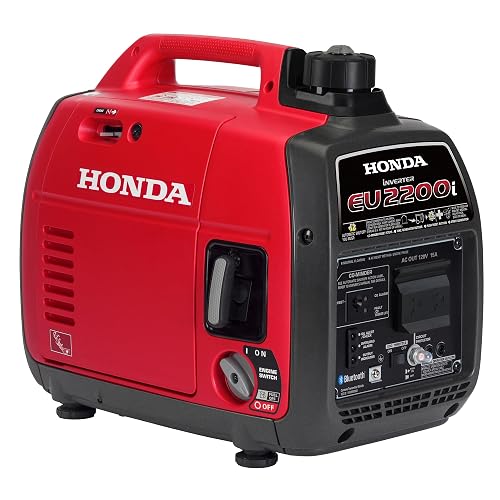 Best for camping with a Honda nameSuper Quiet 120V Gas Powered Portable Generator for Camping or Home BaView on Amazon
Our Top Picks
Quick Comparison
| Product | Best for | Key feature |
|---|---|---|
| Honda EU2200i | Best overall | Quiet, parallel-capable inverter |
| Honda EU7000iS | High wattage needs | 7000 W with 240V output |
| WEN DF680iX | Dual fuel flexibility | Gas or propane operation |
| WEN 56477i | Budget RV setup | 4800 W with fuel shut-off |
| Honda EU1000i | Light loads | Very light, compact frame |
| WEN 56360i | Mid-size campers | 3600 W RV-ready design |
| Honda EU2200i (camping bundle) | Camping with a Honda name | Long run time on one tank |
HondaSuper Quiet 120V Gas Powered Portable Generator for Camping or Home Backup Power Supply, Up to 8.1 Hour Run Time EU2200i
Super Quiet 120V Gas Powered Portable Generator for Camping or Home Backup Power Supply, Up to 8.1 Hour Run Time Honda EU2200i 2200 Watt Inverter Generator (EU2200ITAN)
Best for: Camping with a Honda name
This suits campers who run CPAP machines, phones, laptops and a small fridge and want a quiet, well-supported unit.
Pros
- Manufacturer lists a run time of up to 8.1 hours at quarter load
- Owners often report low noise at campsite distances
Cons
- 2200 W ceiling won’t run an RV air conditioner
HondaSuper Quiet Gas Powered Portable Generator for Camping, RV, Tailgating, or Home Backup Power Supply, Up to 16 Hour Run Time EU7000iS 7000 120/240V Watt Inverter Generator
Super Quiet Gas Powered Portable Generator for Camping, RV, Tailgating, or Home Backup Power Supply, Up to 16 Hour Run Time Honda EU7000iS 7000 120/240V Watt Inverter Generator (EU7000ISNAT1X)
Best for: High wattage needs
Best for larger rigs that need 240V output for an air conditioner or electric range, where the extra capacity matters more than weight.
Pros
- Manufacturer rates 7000 W with both 120V and 240V outlets
- Owners often cite long run times on a full tank
Cons
- Heavy and large for a single person to move
WEN 6800-Watt Dual Fuel RV-Ready Electric Start Portable Inverter Generator with Fuel Shut Off and CO Watchdog for Electric Vehicle Backup
WEN 6800-Watt Dual Fuel RV-Ready Electric Start Portable Inverter Generator with Fuel Shut Off and CO Watchdog for Electric Vehicle Backup (DF680iX)
Best for: Dual fuel flexibility
Fits campers who want to run on gasoline or propane and value electric start and a built-in CO sensor.
Pros
- Listing describes gasoline and propane operation
- Electric start and CO Watchdog are standard features
Cons
- Dual-fuel operation adds setup steps compared with gas-only models
Honda EU2200i 2200 Watt Inverter Generator, Super Quiet 120V Gas Powered Portable Generator for Camping or Home Backup Power Supply, Up to 8.1 Hour Run Time
Honda EU2200i 2200 Watt Inverter Generator, Super Quiet 120V Gas Powered Portable Generator for Camping or Home Backup Power Supply, Up to 8.1 Hour Run Time (EU2200ITAN)
Best for: Best overall
A strong default for couples and small campers who want quiet operation and clean output for electronics.
Pros
- Manufacturer describes the unit as super quiet at light load
- Compact enough to store in a small truck bed or trunk
Cons
- Output limit rules out most air conditioners
WEN Quiet and Lightweight 4800-Watt RV-Ready Portable Inverter Generator with Fuel Shut Off
WEN Quiet and Lightweight 4800-Watt RV-Ready Portable Inverter Generator with Fuel Shut Off (56477i)
Best for: Budget RV setup
Works for campers who need more wattage than a 2000 W unit but want to keep costs and weight down.
Pros
- 4800 W rating covers many RV loads
- Fuel shut-off helps reduce carburetor gumming during storage
Cons
- Louder under heavy load than the Honda inverter models
Buying Guide
Running Wattage for Your Camper Setup
Start by adding up the wattage of the appliances you plan to run at the same time, such as a microwave, air conditioner, or coffee maker. Check the starting (surge) wattage as well, since motors and compressors need more power to start than to keep running. A generator with enough headroom above your typical load will be less strained and quieter at the same time.
Noise Level and Campsite Etiquette
Many campgrounds have quiet hours and noise limits, so a low-noise inverter design matters more than raw power for most campers. Compare the decibel ratings listed by the manufacturer, and remember that a generator’s noise also depends on how much load it is carrying. Placing the unit on the side of your camper away from neighbors and using a rubber mat to reduce vibration can help too.
Clean Power for Sensitive Electronics
Inverter generators produce a stable sine wave, which is safer for laptops, phones, CPAP machines, and modern RV electronics than the rougher output of conventional generators. If you rely on medical devices or sensitive equipment, confirm that the model is labeled as an inverter unit with clean output.
Portability and Weight
Think about whether you will lift and carry the generator alone, and how you will store it between trips. Smaller units in the 1000 to 2200 watt range are much easier to handle than larger 4800 to 7000 watt models. Check dimensions and handle design as well as the listed weight.
Fuel Type and Run Time
Gasoline models are widely available and simple to refuel, while dual fuel units can also run on propane, which is convenient for RV tanks. Run time depends on the fuel tank size and the load, so look at the manufacturer’s stated run time at a given load and plan for refueling on longer trips. Built-in fuel shut-off features can also help with safe transport and storage.
FAQ
Can a honda inverter generator for camper use run an RV air conditioner?
Some models in this list may be able to run a small air conditioner, but this depends on the unit’s rated and starting wattage. Check the air conditioner’s starting requirements against the generator’s specifications before relying on it. Running one large appliance at a time is often the safest approach with smaller units.
Are inverter generators quieter than conventional generators?
In general, inverter generators run at variable engine speeds that adjust to the load, which typically makes them quieter and more fuel efficient. Noise still varies by model and by how much power you are drawing. Comparing the manufacturer’s stated decibel levels is the most reliable way to judge.
Can I parallel two inverter generators for more power?
Some inverter generators offer a parallel kit or parallel capability that lets two matching units share a load. Only pair units that are designed to work together and follow the manufacturer’s instructions exactly. Check the owner’s manual for the specific model before attempting it.
How often should I service a portable inverter generator?
Follow the maintenance schedule in your owner’s manual, which usually covers oil changes, air filter checks, and spark plug inspection. Regular maintenance helps keep the generator reliable and quiet over time. Storing the unit with fuel stabilizer or draining the carburetor can also prevent problems between trips.
Is a carbon monoxide safety feature important?
Yes, because all gasoline and propane generators produce carbon monoxide, which can be deadly in enclosed spaces. Never run any generator inside a camper, tent, or garage, and place it well away from openings. Some models include a CO monitoring feature, but it should supplement, not replace, safe operating practices and a working CO alarm.
Conclusion
For most campers who want quiet, reliable power for phones, lights, and small appliances, a compact Honda model such as the EU2200i is a strong starting point. If you need to run larger loads like an RV air conditioner, the higher-wattage units such as the EU7000iS or the WEN 4800-watt and 6800-watt models deserve a closer look.
Budget-minded RV owners and those who want propane flexibility may prefer the WEN dual fuel or 56477i options, while lighter setups with modest needs can do well with the smaller WEN 3600-watt or Honda EU1000i. Match the wattage, noise level, and weight to how you actually camp, and you will be well served.
Related reading
- Top 6 Inverter Generators for RV Picks Compared for Campers
- Predator vs Honda Inverter Generator: Which Runs Quieter and Lasts Longer (2026)
- Inverter Generator for Camper: How to Choose and Size One (2026)
- Honda Inverter Power Generator Review: Key Features Explained
- Honda Inverter Generator EU2000i: Specs, Noise Data and Buying Guide
- Honda Eu3200i Inverter Generator: Specs, Noise Data and Buying Guide (2026)
- Honda Eu2000i Inverter Generator Manual: Where to Find It and What It Covers
- Honda Eu1000i Generator Inverter Review: Is It Worth It?
About Owen Palmer
Owen Palmer is part of our editorial team and reviews and edits our generators & noise guides, checking product details against manufacturer specifications and owner feedback.