As an Amazon Associate I earn from qualifying purchases. This page may contain affiliate links.
Finding the best dual fuel generator for RV use comes down to a few practical questions: can it plug into a 30-amp RV outlet, will it run on propane when gasoline runs short, and how loud will it be at a campsite where neighbors are close? This guide compares six portable dual fuel models that are commonly marketed for RV use. Our selection weighed published specifications, brand reputation, the presence of RV-ready 30A outlets, CO safety sensors, and general owner feedback patterns. Noise output, fuel flexibility, and inverter technology all factor into the ranking, because an RV generator runs for hours at a stretch and has to coexist with other campers.
Our Top Picks
Quick Comparison
| Product | Best for | Key feature |
|---|---|---|
| WEN DF360iX 3600-Watt Dual Fuel RV-Ready Inverter Generator | Light RV loads and quiet campgrounds | Lightweight inverter design with CO Watchdog |
| WEN DF680iX 6800-Watt Dual Fuel RV-Ready Inverter Generator | Larger RVs and electric start convenience | Electric start with fuel shut-off |
| Westinghouse 4650 Peak Watt Dual Fuel Portable Generator | Shoppers wanting a 30A outlet and a wide power range | RV-ready 30A outlet and CO sensor |
| WEN DF480iX 4800-Watt Dual Fuel RV-Ready Inverter Generator | Mid-size RVs needing more headroom | Electric start with parallel capability |
| ERAYAK 4500W Dual-Fuel Portable Inverter Generator | Compact setups with automatic fuel switching | Auto switch between gas and propane |
| Champion 4000-Watt Dual Fuel RV Ready Portable Inverter Generator | Budget-minded campers who want a 3-year warranty | Recoil start with LPG hose included |
WEN Quiet and Lightweight 3600-Watt Dual Fuel RV-Ready Portable Inverter Generator (DF360iX)

WEN Quiet and Lightweight 3600-Watt Dual Fuel RV-Ready Portable Inverter Generator with Fuel Shut Off and CO Watchdog (DF360iX)
This model suits RV owners running a modest load such as a fridge, lights, fans, and charging devices, especially those who camp in quiet campgrounds where noise limits are enforced.
Key specs
- 3600-watt rated output in a portable inverter frame
- RV-ready configuration
- Dual fuel operation on gasoline or propane
- Fuel shut-off and CO Watchdog protection
Pros
- Lightweight enough for one person to move between campsite and storage
- Inverter design produces cleaner power suited to sensitive electronics
- CO Watchdog adds a safety layer around the RV
Cons
- Limited headroom for running air conditioning alongside other loads
- Smaller tank runtime at full load than larger models
WEN 6800-Watt Dual Fuel RV-Ready Electric Start Portable Inverter Generator (DF680iX)

WEN 6800-Watt Dual Fuel RV-Ready Electric Start Portable Inverter Generator with Fuel Shut Off and CO Watchdog for Electric Vehicle Backup (DF680iX)
This is aimed at larger rigs and campers who want more output for air conditioning or multiple appliances, and who prefer electric start for easier cold-weather use.
Key specs
- 6800-watt class output
- Electric start
- Dual fuel: gasoline or propane
- Fuel shut-off and CO Watchdog protection
Pros
- Electric start removes the pull-cord effort, useful in cold weather
- Higher output gives more room for appliances than 4000-watt units
- Fuel shut-off and CO protection support safer operation
Cons
- Heavier than smaller inverter models, which makes it harder to reposition
- Greater size and weight may be less convenient for tight campsites
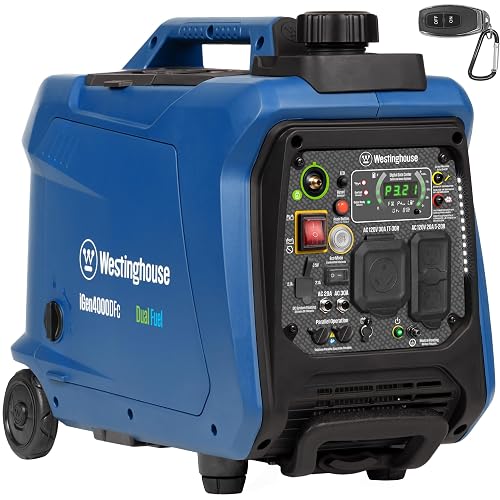
Westinghouse 4650 Peak Watt Dual Fuel Portable Generator

Westinghouse 4650 Peak Watt Dual Fuel Portable Generator, RV Ready 30A Outlet, Gas & Propane Powered, CO Sensor
Best for RV owners who want a dedicated 30A RV outlet on a conventional portable generator and a wide peak-power rating for starting motors and compressors.
Key specs
- 4650 peak watt rating
- RV-ready 30A outlet
- Gas and propane operation
- CO sensor
Pros
- Direct 30A RV outlet simplifies connection to the coach
- Peak rating provides headroom for motor-driven loads
- Runs on gas or propane for flexibility
Cons
- Conventional design is typically louder than inverter generators
- Peak rating differs from continuous output, so check your running wattage needs
WEN Quiet and Lightweight 4800-Watt Dual Fuel RV-Ready Electric Start Portable Inverter Generator (DF480iX)

WEN Quiet and Lightweight 4800-Watt Dual Fuel RV-Ready Electric Start Portable Inverter Generator with Fuel Shut Off and CO Watchdog (DF480iX)
A middle option for mid-size RVs that need more capacity than a 3600-watt unit but do not require the bulk of the 6800-watt model, with electric start for convenience.
Key specs
- 4800-watt class output
- Electric start
- Dual fuel: gasoline or propane
- Fuel shut-off and CO Watchdog protection
Pros
- Good balance of output and portability for most RV setups
- Electric start eases cold-morning starts
- Inverter design supports quieter operation than conventional units
Cons
- Output sits between two common sizes, so verify your total wattage first
- Heavier than the 3600-watt model when moved between sites
ERAYAK 4500W Dual-Fuel Portable Inverter Generator for Home Use, Camping Outdoor, 30A RV Ready

ERAYAK 4500W Dual-Fuel Portable Inverter Generator for Home Use, Camping Outdoor, 30A RV Ready, Auto Switch, Gas and Propane Powered, EPA, CO Sensor, Parallel Ready, Campact Design
This suits campers who value automatic switching between gasoline and propane and want a compact frame that also supports parallel operation with a second unit.
Key specs
- 4500-watt class output
- 30A RV-ready configuration
- Auto switch between gas and propane
- EPA listing and CO sensor
- Parallel ready
Pros
- Automatic fuel switching reduces manual changeovers
- Parallel capability allows future expansion for larger loads
- Compact design fits tight storage compartments
Cons
- Less established brand footprint than some competitors in the RV market
- Owners should confirm parallel cable and kit requirements before buying
Champion 4000-Watt Dual Fuel RV Ready Portable Inverter Generator

Gas & Propane Powered, LPG Hose, RV Ready, Recoil Start, Parallel Ready, Quiet Technology, Free 3-Year Warranty Champion 4000-Watt Dual Fuel RV Ready Portable Inverter Generator
A practical choice for budget-minded campers who want an RV-ready dual fuel generator with an included LPG hose and a three-year warranty, and who don’t mind a recoil starter.
Key specs
- 4000-watt class output
- Gas and propane operation
- RV ready
- Recoil start
- Parallel ready
- LPG hose included
Pros
- Included LPG hose means propane operation works out of the box
- Warranty coverage is a point in its favor for long-term ownership
- Parallel-ready design supports later expansion
Cons
- Recoil start requires more effort than electric start, especially in cold weather
- Output is lower than the 4800- and 6800-watt models for heavier loads
Buying Guide
Choosing the best dual fuel generator for RV camping starts with matching the machine to your coach and your habits. The points below help you narrow the field before comparing individual models.
Selection Criteria
Start with your actual electrical load. Add the running wattage of the appliances you intend to power, then add a margin for startup surges from air conditioners and compressors. Most RV owners running air conditioning need a larger generator than those running only lights, fans, and charging gear.
Important Features
- Inverter vs. conventional design: Inverter generators typically produce cleaner power and run quieter at partial load, which matters in campgrounds.
- RV-ready 30A outlet: A dedicated 30-amp outlet lets you connect directly to the coach’s inlet with a standard cord.
- Dual fuel capability: Gasoline offers wide availability, while propane stores longer and burns cleaner. Being able to switch matters on long trips.
- CO protection: Look for a CO sensor or shutdown feature, and always place the generator well away from the RV’s openings.
- Electric start: Helpful in cold weather or for users who find pull-cords difficult.
Specs to Check
Compare rated running watts against peak watts. Running watts reflect what the unit can supply continuously, and that is the number that matters for an RV that will run for hours. Also check noise output in decibels at a stated distance, fuel run time at half load, and whether the unit supports parallel operation with a second machine.
Choosing by Need
- Light loads and quiet sites: a 3600-watt inverter model is usually sufficient for fans, lights, and electronics.
- Mid-size RVs: a 4000- to 4800-watt unit balances capacity and portability.
- Air conditioning and larger loads: a 6800-watt-class generator or a parallel setup gives the necessary headroom.
- Frequent movement: prioritize weight and frame design.
Things to Watch Out For
Never run any portable generator inside a garage, tent, or enclosed compartment. Keep it at least the distance recommended by the manufacturer from the RV, and point the exhaust away from awnings and windows. Check that your fuel hoses and regulators are rated for propane use, and store fuel according to local rules. Consult a qualified RV technician or electrician if you are connecting to the coach’s electrical system or installing a transfer switch.
FAQ
Can a dual fuel generator run an RV air conditioner?
Some can, but it depends on the air conditioner’s running and starting wattage. Check the unit’s nameplate, then confirm the generator’s continuous rating and surge capacity. Many owners find a 6800-watt-class generator or a parallel setup more suitable for AC use than a 3600-watt model.
Is propane or gasoline better for RV generator use?
Propane stores indefinitely and burns cleaner, which suits long-term storage. Gasoline is easier to find at many roadside stations. Dual fuel models let you use whichever is convenient at the time.
What does a 30A RV-ready outlet mean?
It means the generator provides a 30-amp, 120-volt connection compatible with the standard RV power cord. This lets you plug the coach in without a separate adapter for the generator’s own outlets.
How loud are inverter generators at a campsite?
Noise varies by model and load. Inverter designs generally run quieter at partial load than conventional generators, and many campgrounds set quiet hours. Compare the manufacturer’s stated decibel rating at a given distance rather than relying on general impressions.
Can I run two generators in parallel?
Only if both units are parallel-ready and you use the manufacturer’s approved parallel cable. Running two generators together can roughly double available power for larger loads, but both must be the same model and in good condition.
Do I need a CO detector if the generator has CO protection?
A CO sensor on the generator is a useful safety feature, but it does not replace an RV carbon monoxide detector. Keep a working detector inside the coach and maintain good ventilation around the generator.
Is an electric start worth it for RV use?
Electric start is convenient, especially in cold weather or for users who find pull-cords hard to operate. Recoil start units are simpler and lighter, and many campers are comfortable using them.
Conclusion
For light RV loads and quiet campgrounds, the WEN DF360iX is the most portable option in this list. Mid-size rigs that need more margin will find the WEN DF480iX a sensible middle ground, while the WEN DF680iX suits larger coaches and air conditioning. The Westinghouse 4650 Peak Watt is a strong pick when a direct 30A RV outlet is the priority. The ERAYAK 4500W suits those who want automatic fuel switching and parallel expansion, and the Champion 4000-Watt suits budget-minded campers who value an included LPG hose and a long warranty. Match your choice to your measured wattage needs, and consult a qualified technician before any permanent electrical connection.