 By Owen Palmer
Updated November 2026
Shopping for a 4000 watt inverter generator with remote start usually comes down to three things: whether it can run your essentials without a cord-pull routine, how loud it is at the distance you actually sit or sleep, and which fuel options it supports during an outage. The picks below are based on product listings, brand reputation and common owner feedback patterns. None of them were tested in a lab or in our own hands.
Our top picks at a glance
- 1
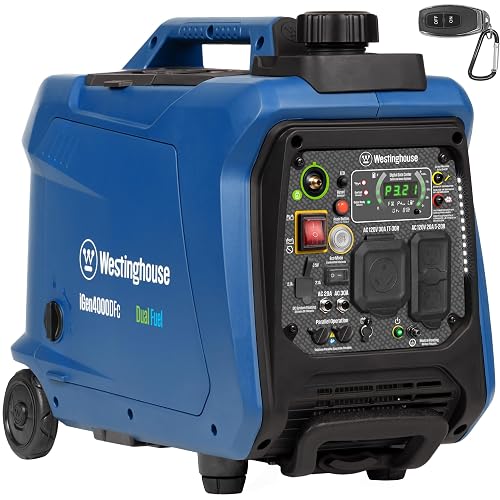 TOP CHOICEBest overallWestinghouse 4000 Peak Watt Super Quiet Dual Fuel Portable Inverter GeneratorView on Amazon
- 2
 TOP CHOICEBest for RV and campersPulsar PG5000BiSRCO Dual Fuel 30A RV Ready Portable Inverter GeneratorView on Amazon
- 3
 TOP CHOICEBest for budget-minded buyersLIFAN 4800W Gas Inverter Generator, Remote Start, 30A RV ReadyView on Amazon
- 4
 Best for propane-first setupsChampion 4000-Watt Dual Fuel RV Ready Portable Inverter GeneratorView on Amazon
- 5
 Best for portabilityWEN 4800-Watt Dual Fuel RV-Ready Electric Start Portable Inverter GeneratorView on Amazon
- 6
 Best for whole-home backupWestinghouse 8200 Peak Watt Tri-Fuel Portable Inverter Generator, RemoView on Amazon
Our Top Picks
Quick Comparison
| Product | Best for | Key feature |
|---|---|---|
| Westinghouse 4000 Peak Watt Super Quiet Dual Fuel | Overall balance | Super quiet dual fuel |
| Pulsar PG5000BiSRCO Dual Fuel 30A | RV and campers | 30A RV-ready outlet |
| LIFAN 4800W Gas Inverter Generator | Budget-minded buyers | Gasoline with remote start |
| Champion 4000-Watt Dual Fuel RV Ready | Propane-first setups | LPG hose and parallel ready |
| WEN 4800-Watt Dual Fuel RV-Ready | Portability | Lightweight with CO Watchdog |
| Westinghouse 8200 Peak Watt Tri-Fuel | Whole-home backup | Tri-fuel and transfer switch ready |
Westinghouse 4000 Peak Watt Super Quiet Dual Fuel Portable Inverter Generator
Westinghouse 4000 Peak Watt Super Quiet Dual Fuel Portable Inverter Generator, Remote Electric Start, Gas & Propane Powered, RV Ready, CO Sensor, Parallel Capable
Best for: Overall balance of noise, fuel flexibility and remote start.
This suits homeowners who want one dependable unit for a refrigerator, lights and a few devices during short outages, and who value a quieter operating note.
Pros
- Runs on gasoline or propane
- Remote electric start and CO sensor
Cons
- Propane output is lower than gasoline output
Pulsar PG5000BiSRCO Dual Fuel 30A RV Ready Portable Inverter Generator
Pulsar PG5000BiSRCO Dual Fuel 30A RV Ready Portable Inverter Generator with Remote Start
Best for: RV and camper use with a 30A outlet.
It fits owners who need a 30-amp connection for a trailer or motorhome and want the option of running on either gasoline or propane.
Pros
- 30A RV-ready outlet
- Dual fuel flexibility
Cons
- Heavier than compact inverter models
LIFAN 4800W Gas Inverter Generator, Remote Start, 30A RV Ready
Gasoline powered, 3800W running output, remote/electric start, CO sensor, eco mode LIFAN 4800W Gas Inverter Generator, Remote Start, 30A RV Ready
Best for: Budget-minded buyers who want remote start on gasoline.
It appeals to people who mainly need gasoline backup and want remote start and an RV-ready outlet without moving into premium territory.
Pros
- Remote electric start on gasoline
- Eco mode for lower fuel draw at light loads
Cons
- Gasoline-only, so no propane fallback
Champion 4000-Watt Dual Fuel RV Ready Portable Inverter Generator
Gas & Propane Powered, LPG Hose, RV Ready, Recoil Start, Parallel Ready, Quiet Technology, Free 3-Year Warranty Champion 4000-Watt Dual Fuel RV Ready Portable Inverter Generator
Best for: Propane-first setups and parallel expansion.
It suits buyers who store propane for long outages and may want to add a second unit later for more output.
Pros
- LPG hose included and parallel ready
- Recoil start backup if the battery fails
Cons
- Recoil start is less convenient than remote start in daily use
WEN 4800-Watt Dual Fuel RV-Ready Electric Start Portable Inverter Generator
WEN Quiet and Lightweight 4800-Watt Dual Fuel RV-Ready Electric Start Portable Inverter Generator with Fuel Shut Off and CO Watchdog (DF480iX)
Best for: Portability and a built-in CO safety watchdog.
It fits households that want a lighter unit they can move by hand and that include a fuel shut-off and CO monitoring.
Pros
- Lightweight for a 4000-watt class unit
- Fuel shut-off and CO Watchdog
Cons
- Electric start rather than true remote start
Buying Guide
Running Watts vs. Starting Watts
A 4000 watt inverter generator is rated by peak output, but the number that matters day to day is running watts. Add up the wattage of the devices you plan to run at the same time, such as a refrigerator, a furnace fan, lights and a phone charger, and leave some margin. Motors like well pumps and refrigerator compressors need extra power to start, so check that the generator can handle that surge.
Noise Level and Where You Will Use It
Inverter generators are generally quieter than conventional open-frame models because they adjust engine speed to the load. Still, the decibel rating on a listing is measured under specific conditions, so treat it as a comparison point rather than a guarantee. If the unit will sit near a bedroom window or a campsite, look for models that advertise eco modes or quiet operation and plan to place the unit as far from living space as your extension cords allow.
Fuel Options and Runtime
Some models run only on gasoline, while dual fuel units can also run on propane, which stores longer and is easier to keep on hand for emergencies. Check the stated runtime on a single tank or at a given load, and consider whether you can store enough fuel safely. Propane use also depends on tank size and connection type, so confirm which hoses or adapters are included.
Remote Start, Safety Features and Connectivity
Remote or electric start is useful when the generator sits outside in bad weather or is tucked away from the house. Also look for a built-in CO sensor or shutoff feature, since carbon monoxide safety is critical with any fuel-burning generator. If you plan to connect the unit to your home wiring, check whether a transfer switch is supported and whether the outlets and parallel capability fit your setup.
FAQ
Can a 4000 watt inverter generator power a whole house?
Usually not. A 4000 watt unit is best suited for essential circuits such as a refrigerator, lights, a sump pump, a furnace blower and a few electronics. Running an entire home typically requires a larger standby system or a careful load plan.
Is remote start worth paying more for?
For many households it is. Remote start lets you fire up the generator from indoors, which is safer and more convenient during storms or at night. If the unit will sit in an easy-to-reach spot, a recoil start may be enough.
Can I run a 4000 watt generator in the rain?
Do not run it unprotected in the rain. Use a generator cover or a weather-resistant canopy designed for ventilation, and keep the unit at least several feet from the house with the exhaust pointed away from doors and windows.
Do I need a transfer switch to connect the generator to my home?
Yes, if you want to power household circuits directly. A transfer switch or properly installed interlock kit prevents backfeeding into the utility lines, which is dangerous to line workers. Consult a licensed electrician before wiring the generator into your panel.
How often should I service an inverter generator?
Follow the manufacturer’s maintenance schedule, which generally includes oil changes, air filter checks and spark plug inspections. Run the generator periodically under load, and use fuel stabilizer if you store gasoline for long periods.
Conclusion
If you want the most fuel flexibility and a general-purpose backup for essentials, a dual fuel model with remote start and a CO sensor is a strong fit. Buyers focused on RV or camping use may prefer a model with an RV-ready 30A outlet and parallel capability, while those on a tighter budget can consider a gasoline-only unit with recoil or electric start.
Whichever option you choose, match the running watts to your essential loads, plan for safe placement away from the home, and keep the manufacturer’s maintenance schedule. A little preparation before an outage makes a 4000 watt inverter generator far more useful when you need it.
Related reading
- Westinghouse Dual Fuel Inverter Generator with Remote Start: 7 Best Picks (2026)
- Champion Inverter Generator with Remote Start: 7 Best Picks for 2026
- Champion Dual Fuel Inverter Generator with Remote Start: 6 Best Picks (2026)
- 7 Best Generator Inverters with Remote Start for Home Backup (2026)
- 7 Best Dual Fuel Inverter Generators with Remote Start for Home Backup (2026)
- Yamaha Ef2200is 2200 Watt Inverter Generator: Setup, Noise and Safe Use (2026)
About Owen Palmer
Owen Palmer is part of our editorial team and reviews and edits our generators & noise guides, checking product details against manufacturer specifications and owner feedback.