By Owen Palmer
Updated November 2026
Choosing an inverter generator for refrigerator backup comes down to three things: enough running wattage to start and run the compressor, low enough noise to live with during an outage, and a fuel tank that keeps the unit going through a long night. This guide compares seven models on those criteria. We looked at manufacturer specifications, brand reputation, and the patterns owners tend to report about runtime, noise and starting power, rather than running any of these units ourselves. A standard refrigerator often needs 600 to 800 running watts, but it can draw two to three times that for a few seconds when the compressor kicks on, so starting capacity matters as much as the rated number on the label.
Our top picks at a glance
- 1
 TOP CHOICEBest overallPower Equipment 4400 Watts Inverter GeneratorView on Amazon
- 2
 TOP CHOICEBest for quiet operationPowerSmart 3800 Watt Portable Inverter GeneratorView on Amazon
- 3
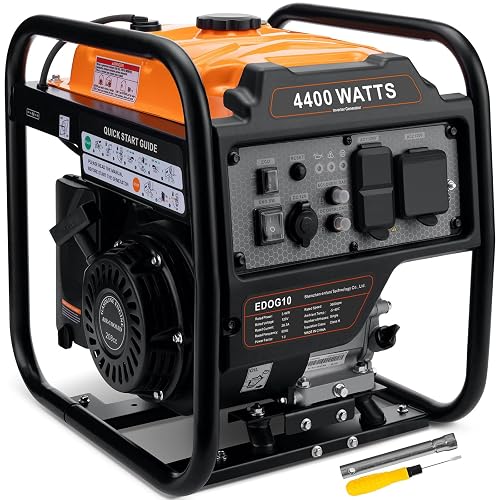 TOP CHOICEBest for RV and home dual use4400-Watts Inverter Generator Open FrameView on Amazon
- 4
 Best for small kitchens2800-Watts Portable Inverter Generator with Fuel Shut OffView on Amazon
- 5
 Best budget pick2800W Portable Inverter Generator for Camping and Home BackupView on Amazon
- 6
 Best for extended runtime5000-Watts Inverter Generator for Camping and Home UseView on Amazon
- 7
 Best dual fuel optionWestinghouse 2800 Peak Watt Dual Fuel Portable Inverter GeneratorView on Amazon
Our Top Picks
Quick Comparison
| Product | Best for | Key feature |
|---|---|---|
| Power Equipment 4400 Watts Inverter Generator | Best overall | 4400 rated watts with ECO Mode |
| PowerSmart 3800 Watt Portable Inverter Generator | Best for quiet operation | Rated under 59 dBA with under 3% THD |
| 4400-Watts Inverter Generator Open Frame | Best for RV and home dual use | 30A RV-ready outlet |
| 2800-Watts Portable Inverter Generator | Best for small kitchens | Fuel shut-off and 1.1 gal tank |
| 2800W Portable Inverter Generator | Best budget pick | Compact, lightweight build for camping |
| 5000-Watts Inverter Generator | Best for extended runtime | 5000 rated watts and ECO Mode |
| Westinghouse 2800 Peak Watt Dual Fuel Inverter Generator | Best dual fuel option | Gas or propane with CO sensor |
Power Equipment 4400 Watts Inverter Generator
Power Equipment 4400 Watts Inverter Generator Gas Powered, Portable Open Frame Generator, Low Noise with ECO Mode, RV Ready, Emergency Home Backup
Best for: Best overall
This is a fit for homeowners who want a single unit that can carry a refrigerator, a few lights and a phone-charging station through an outage. The 4400-watt rating leaves headroom for the compressor’s startup surge.
Key specs:
- Rated output: 4400 watts
- Open frame design
- ECO Mode for reduced fuel use at light loads
Pros:
- Enough rated capacity for most standard refrigerators
- ECO Mode helps extend fuel life
- Emergency home backup is a stated primary use
Cons:
- Open frame design is louder than enclosed models
- Heavier than the 2800-watt options
Bottom line: Best for households that want the most rated capacity in a single unit and can accept some extra noise.
PowerSmart 3800 Watt Portable Inverter Generator
Super Quiet <59dBA, Long Runtime, Eco Mode, <3% THD Clean Power PowerSmart 3800 Watt Portable Inverter Generator for Home Use
Best for: Best for quiet operation
Suited to households near neighbors or bedrooms, where a refrigerator-backup unit may run for many hours overnight. The listing emphasizes low noise and clean power output.
Key specs:
- Rated output: 3800 watts
- Noise rating listed under 59 dBA
- Total harmonic distortion listed under 3%
Pros:
- Listed noise level is among the quieter figures in this group
- Clean power output suits sensitive electronics
- Long runtime is a stated feature
Cons:
- Lower rated watts than the 4400-watt models
- Noise figures are manufacturer-stated and vary with load and placement
Bottom line: A strong choice if noise is the deciding factor and your refrigerator is the main load.
4400-Watts Inverter Generator Open Frame
4400-Watts Inverter Generator, Open Frame Generator Gas Powered, Emergency Home Backup, RV Ready 30A Outlet, EPA Compliment
Best for: Best for RV and home dual use
A good match for people who want one generator for home outages and for camping or RV trips. The listing notes an RV-ready 30A outlet.
Key specs:
- Rated output: 4400 watts
- 30A RV-ready outlet
- Open frame construction
Pros:
- RV-ready outlet adds versatility
- Rated capacity suits a full-size refrigerator
- Emergency backup is a listed use
Cons:
- Open frame design means more noise than enclosed units
- Requires careful outdoor placement for ventilation
Bottom line: Pick this if you want one machine that covers both home backup and recreational use.
2800-Watts Portable Inverter Generator with Fuel Shut Off
2800-Watts Portable Inverter Generator, Gas Generators for Home Use, Camping, Super Quiet Emergency Home Backup, with Fuel Shut Off, 1.1Gal Fuel Tank, 39Lbs, EPA Compliant
Best for: Best for small kitchens
Better suited to a smaller refrigerator or a refrigerator plus a few lights. Its lighter weight makes it easier to move around a home or garage.
Key specs:
- Rated output: 2800 watts
- Fuel tank capacity: 1.1 gallons
- Weight: 39 lbs
- Fuel shut-off feature
Pros:
- Lightweight and portable
- Fuel shut-off aids safe transport
- Good fit for smaller households
Cons:
- Lower wattage may not start a large refrigerator reliably
- Small tank means shorter runtime between refuels
Bottom line: Best for compact refrigerators and light backup loads where portability matters.
2800W Portable Inverter Generator for Camping and Home Backup
2800W Portable Inverter Generator, Quiet Gas Generator for Camping, RVs, Home Backup and Outdoor Activities, EPA Compliant
Best for: Best budget pick
A practical option for people who want a modest-wattage unit for occasional outages and weekend camping. Budget-minded buyers often weigh it against the 3800-watt models.
Key specs:
- Rated output: 2800 watts
- EPA compliant
- Designed for camping, RVs and home backup
Pros:
- Versatile across camping and home use
- EPA compliance is listed
- Compact enough for easy storage
Cons:
- Limited headroom for refrigerator startup surge
- Fewer detailed specs in the listing than premium models
Bottom line: Good for light refrigerator loads and mixed-use buyers who accept a tighter power margin.
5000-Watts Inverter Generator for Camping and Home Use
for Camping, Home Use, 70dB, 60Lbs, RV Ready, ECO Mode, EPA Compliment 5000-Watts Inverter Generator, Portable Gas Generator
Best for: Best for extended runtime
This is aimed at users who expect longer outages and want the highest rated wattage in this lineup. The listing cites a 70 dB noise figure and ECO Mode.
Key specs:
- Rated output: 5000 watts
- Noise figure listed at 70 dB
- Weight: 60 lbs
- ECO Mode
Pros:
- Highest rated wattage in this group
- ECO Mode supports longer runtime at light loads
- RV-ready and home-use listed
Cons:
- Heaviest option at 60 lbs
- 70 dB is louder than the 59 dBA quiet-operation pick
Bottom line: Choose this when raw capacity and runtime matter more than quiet operation.
Westinghouse 2800 Peak Watt Dual Fuel Portable Inverter Generator
Westinghouse 2800 Peak Watt Super Quiet & Lightweight Dual Fuel Portable Inverter Generator, Gas & Propane Powered, CO Sensor, Parallel Capable, Long Run Time
Best for: Best dual fuel option
Useful for households that want the option to run on gasoline or propane, which can matter when fuel supply is uncertain during a storm. The listing includes a CO sensor and parallel capability.
Key specs:
- Rated output: 2800 peak watts
- Dual fuel: gas and propane
- CO sensor
- Parallel capable
Pros:
- Dual fuel gives flexibility during outages
- CO sensor adds a safety layer
- Parallel capability allows added power later
Cons:
- 2800 peak watts leaves limited startup margin for a large refrigerator
- Propane runtime is typically shorter than gasoline per unit of fuel
Bottom line: A solid pick for buyers who need fuel flexibility and can pair it with a parallel unit if needed.
Buying Guide
Running Watts and Starting Watts
A refrigerator’s compressor can draw a large surge when it starts. Many owners size a generator to at least 2 to 3 times the refrigerator’s running wattage to avoid stalling. Check the nameplate on your refrigerator for running amps, then multiply by voltage to estimate running watts.
Good picks for this: Power Equipment 4400 Watts Inverter Generator, 4400-Watts Inverter Generator Open Frame
Noise Level in Decibels
Manufacturers often list noise in dBA at a set distance, usually 23 feet. A 10 dB drop sounds roughly half as loud to most listeners. For overnight backup near a bedroom, a rating under 60 dBA is a useful target, though real-world noise depends on load and placement.
Good picks for this: PowerSmart 3800 Watt Portable Inverter Generator, 2800-Watts Portable Inverter Generator with Fuel Shut Off
Runtime and Fuel Tank Size
Runtime depends on tank size and load. A 1.1-gallon tank will run far shorter than a larger tank at the same load. Calculate runtime by dividing tank capacity by the fuel consumption rate at your typical load, and plan refueling around that figure.
Good picks for this: 5000-Watts Inverter Generator for Camping and Home Use, 2800W Portable Inverter Generator for Camping and Home Backup
Fuel Type: Gasoline, Propane and Dual Fuel
Gasoline is widely available but can go stale in storage. Propane stores indefinitely and burns cleaner, though it usually yields fewer running hours per unit of fuel. Dual-fuel units let you switch depending on supply during an outage.
Good picks for this: Westinghouse 2800 Peak Watt Dual Fuel Portable Inverter Generator
Portability and Weight
Weight determines whether one person can move the unit safely. Units in the 39-lb range are much easier to carry than 60-lb models, which may need two people or a cart. Consider where the generator will be stored and how far it needs to travel to the outdoor run location.
Good picks for this: 2800-Watts Portable Inverter Generator with Fuel Shut Off, 2800W Portable Inverter Generator for Camping and Home Backup
Safety Features and Carbon Monoxide Protection
Carbon monoxide is odorless and can be deadly. Generators must run outdoors, well away from windows and doors. Built-in CO sensors and automatic shutoffs add protection, but they do not replace correct placement. If you have questions about installing a transfer switch or sizing a backup system for your home, consult a licensed electrician.
Good picks for this: Westinghouse 2800 Peak Watt Dual Fuel Portable Inverter Generator, 2800-Watts Portable Inverter Generator with Fuel Shut Off
Clean Power and Electronics
Inverter generators produce a sine wave with low total harmonic distortion, which is gentler on modern electronics than older conventional designs. Look for THD figures under 3% when running sensitive equipment alongside a refrigerator.
Good picks for this: PowerSmart 3800 Watt Portable Inverter Generator, Power Equipment 4400 Watts Inverter Generator
FAQ
What size inverter generator do I need for a refrigerator?
Most standard refrigerators run on 600 to 800 watts but can surge higher at startup. A generator rated at 2000 watts or more is a common minimum, and 3000 to 4400 watts gives more margin for startup surges and additional loads.
Can an inverter generator run a refrigerator continuously?
Yes, if the unit has enough rated capacity and enough fuel for the expected outage. Plan refueling and check manufacturer guidance on continuous operation before relying on it overnight.
Is an inverter generator quieter than a standard generator?
Generally, inverter designs vary engine speed to match load, which often reduces noise at light loads compared with fixed-speed generators. Actual noise depends on the model, load and distance.
Is it safe to run a generator indoors near a refrigerator?
No. Generators produce carbon monoxide and must be run outdoors, away from doors, windows and vents. Install a CO alarm inside the home. For wiring a generator to your house, consult a licensed electrician.
What is the difference between running watts and starting watts?
Running watts is the steady power a device draws. Starting watts is the short surge needed to start a motor, such as a refrigerator compressor. Choose a generator whose starting rating covers that surge.
Can I connect two inverter generators to get more power?
Some models support parallel operation through a compatible cable or kit. Check the manufacturer’s instructions and confirm that both units are the same model and configuration.
Conclusion
For most households, the Power Equipment 4400 Watts Inverter Generator offers the most rated capacity for a refrigerator and a few additional loads. Buyers who prioritize quiet overnight operation should look at the PowerSmart 3800 Watt model, while RV-minded users may prefer the 4400-watt open frame unit with its 30A outlet. Smaller refrigerators and light loads suit the 2800-watt options, and the Westinghouse dual-fuel unit fits buyers who want gas or propane flexibility. Match the wattage to your refrigerator’s startup surge, check decibel ratings for your setting, and plan fuel for the outage length you expect.
Sources
- Guidance on sizing backup power and safe generator use (energy.gov)
- Consumer safety recalls and carbon monoxide warnings for portable generators (cpsc.gov)
- Fire and electrical safety standards relevant to standby and portable power (nfpa.org)
Related reading
- Wen Inverter Generator 2000w: Specs, Noise Data and Buying Tips
- WEN 6800 Dual Fuel Inverter Generator Review: Is It Worth It?
- Top 7 LP Gas Inverter Generators Compared for Home and RV Use
- Top 7 Champion 5500W Dual Fuel Inverter Generator Picks Compared
- Top 6 Inverter Generators for RV Picks Compared for Campers
- Top 5 Dual Fuel Generator Inverter Models for Home Backup and RV Use
About Owen Palmer
Owen Palmer is part of our editorial team and reviews and edits our generators & noise guides, checking product details against manufacturer specifications and owner feedback.